
Why Leadership Offsites Fail and What Actually Creates Change
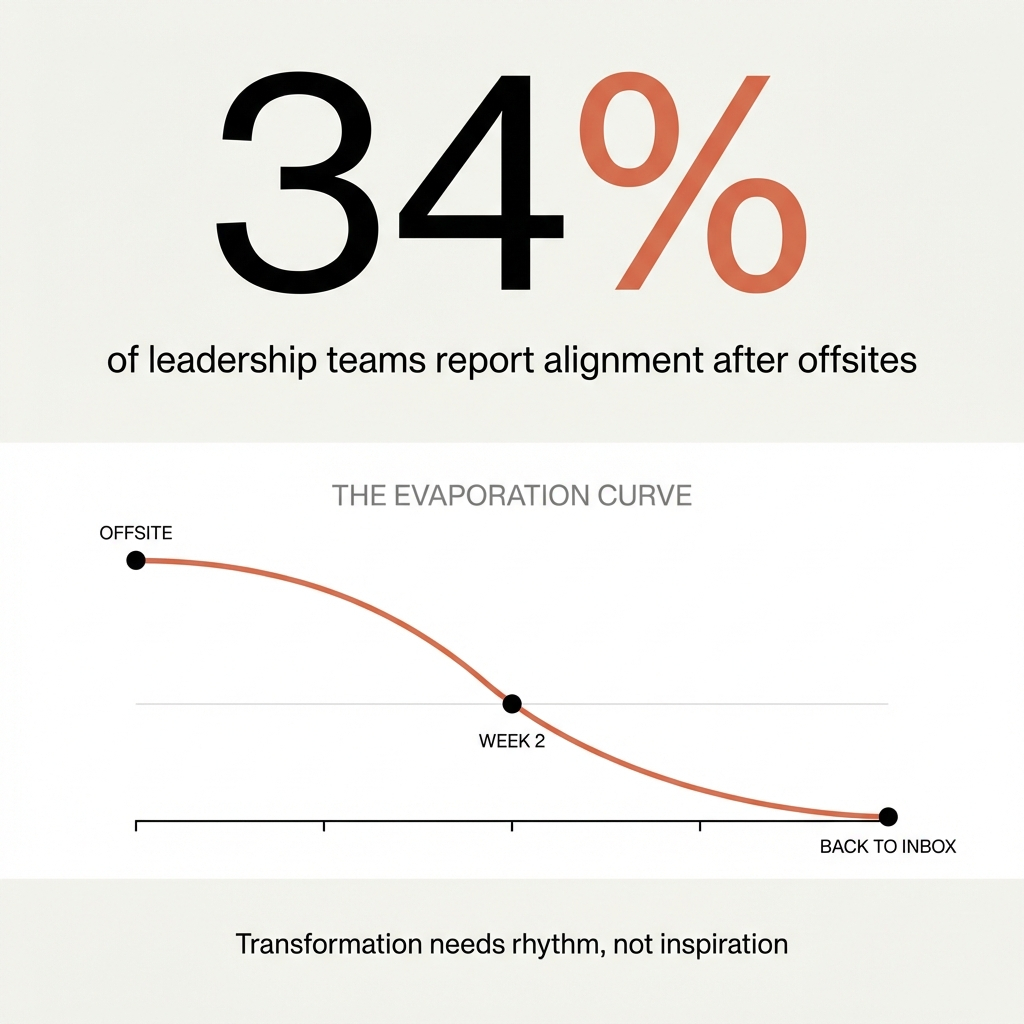
We've watched the same pattern repeat dozens of times. Leadership teams leave their offsite energized, aligned, and committed to transformation. Two weeks later, they're back to the same meetings, the same conflicts, and the same fragmented priorities they had before they left.
The problem isn't the offsite. It's what happens when everyone returns to their inboxes.
Most leadership offsites fail because they treat transformation as an event rather than a system. You gather your team, invest in a beautiful location, bring in facilitators, and generate breakthrough insights. Then you return to an operating environment that has no structural capacity to sustain what you just created.
The Data Tells the Uncomfortable Truth
Only 34% of executive teams report strong alignment on strategic priorities after their annual leadership offsite. That means two-thirds of teams leave their retreat without the one thing the retreat was designed to produce.
The gap gets worse when you look at execution. 67% of well-formulated strategies fail due to poor execution, according to research cited by Harvard Business Review. The boardroom commitments don't survive contact with operational reality.
The issue isn't strategic thinking. Leadership teams are perfectly capable of identifying the right priorities during a focused offsite. The issue is the absence of rhythm that connects those priorities to repeated action. Without that rhythm, the offsite becomes a moment of clarity followed by months of drift.
Why Inspiration Evaporates
We've learned that people are remarkably poor at predicting their future behavior. Research in cognitive psychology shows this repeatedly. When your team commits to new practices during the offsite, they're making promises about a future state they cannot accurately predict.
They haven't experienced the friction of implementing the new approach. They haven't felt the competing demands that will emerge. They haven't encountered the moment when the old pattern feels easier than the new commitment.
This explains why offsite commitments evaporate so quickly. Your team isn't lying when they agree to the new direction. They genuinely believe they'll follow through. But belief without structure produces temporary enthusiasm, not sustained change.
The research backs this up. An IMD global study of 500 executives found that managers believe only one in two attempts to change employee behavior succeeds. More concerning: only one in ten managers knows how to sustain behavior change over time.
The Structural Problem Nobody Addresses
Most offsites fail at a deeper level than inspiration or commitment. They fail because leadership teams don't have a unified operating rhythm that can absorb and execute new strategic direction.
Your team spends two days generating breakthrough insights. Then they return to an environment where 85% of leadership teams spend less than one hour per month on strategy, and 50% spend no time at all. The offsite becomes an exception to a rhythm that doesn't exist.
The real failure isn't what happens during the offsite. It's the absence of structural accountability that should exist before and after. Without recurring cadence that forces alignment verification, strategic clarity, and progress measurement, your offsite insights have nowhere to live.
We've seen this pattern enough to recognize it immediately. Teams show up to their retreat location and dive into packed agendas full of dense reports and endless updates. They treat the retreat like any other meeting. The result is predictable: limited insight, stale thinking, and teams that leave more exhausted than inspired.
The Cascade Problem
Even when leadership teams achieve genuine alignment during the offsite, they face a different structural failure. The strategic clarity they created doesn't cascade beyond the room.
Research from Harvard shows that only 13% of management, 8% of middle management, and 2% of employees can accurately articulate their company's strategy as officially defined. If your leadership team cannot translate offsite decisions into execution clarity for the broader organization, the retreat was performative, not transformational.
This isn't a communication problem. It's an architecture problem. Your organization doesn't have the structural mechanisms to convert leadership alignment into distributed action. The offsite produces a moment of unity at the top while the rest of the organization continues operating on conflicting interpretations of priority.
What Actually Creates Lasting Change
We've learned that transformation requires installation, not inspiration. You need to build the operating rhythm before the offsite, use the offsite to generate strategic clarity within that rhythm, then return to a structure that enforces what you decided.
This means your leadership team needs recurring cadence that includes strategic thinking time, alignment verification, and progress measurement. Not quarterly. Not monthly. Weekly. The rhythm has to be frequent enough that drift becomes impossible.
The offsite becomes valuable when it serves the rhythm, not replaces it. You use the extended time to tackle the strategic questions that require deeper thinking. But the decisions you make during the offsite flow into the weekly cadence that already exists. The structure absorbs the new direction and converts it into repeated execution.
Companies with aligned leadership teams are 2.5 times more likely to outperform peers on revenue growth. But alignment isn't achieved through annual inspiration. It's achieved through structural rhythm that makes misalignment visible and correctable every single week.
The Follow-Through Architecture
Research on workplace behavior change shows that without ongoing follow-through mechanisms, retreat learnings decay rapidly. You need coaching for executives, follow-up sessions, and processes that revisit key takeaways during regular meetings.
But most organizations don't clarify these mechanisms before leaving the retreat. The energy dissipates during the transition back to operational reality. Momentum dies in the gap between commitment and structure.
We've found that the teams who succeed do something simple. They define the follow-through architecture before they leave the offsite. They identify which decisions require weekly verification. They assign clear ownership. They build the new commitments directly into their existing operating rhythm.
This isn't complicated. It's just rarely done. Most teams assume the inspiration will carry them through. Then they're surprised when it doesn't.
The Real Work Starts Monday
The offsite creates potential. The rhythm creates results.
Your leadership team doesn't need another inspiring retreat. You need an operating system that can sustain the decisions you make during that retreat. You need weekly cadence that forces strategic thinking, verifies alignment, and measures progress. You need structural accountability that makes drift impossible.
The transformation you're seeking won't come from a better facilitator or a more beautiful location. It will come from building the architecture that makes Monday morning different than it was before you left.
Most strategies don't fail in the boardroom. They fail in the gap between leaders who say they're aligned and those who actually are. Six months after ambitious strategies are announced with polished presentations and confident timelines, those same strategies have devolved into competing initiatives that bear little resemblance to the original vision.
The offsite can create clarity. But only rhythm creates compound momentum. Only structure converts inspiration into sustained execution. Only unified operating cadence transforms leadership teams from groups that meet occasionally into systems that execute consistently.
That's the work. Not the two days away. The rhythm you build before and after.