
What Actually Happens When You Run the Same Meeting Every Week for 90 Days
We started noticing something strange about six months into working with scaling companies. The ones that transformed weren't the ones with the best strategy. They weren't the ones with the most talented teams or the biggest budgets.
They were the ones who showed up to the same meeting, with the same agenda, tracking the same metrics, every single week. For at least 90 days straight.
This wasn't what we expected to find. We thought the breakthroughs would come from strategic clarity or better frameworks. But the actual mechanism of transformation turned out to be far more mechanical than that.
The Pattern We Kept Seeing
Most leadership teams operate in what we call distributed instinct mode. The founder or CEO holds the operating system in their head. Everyone else interprets signals, makes assumptions, and moves forward based on incomplete information.
This works fine until you hit somewhere between $1M and $3M in revenue with 10 to 30 people on the team. That's when the complexity wall emerges. Decision-making slows down. Work gets duplicated. Cracks become visible.
The failure isn't strategic. It's structural. The founder's cognitive capacity has hit its ceiling, and the organization has exceeded what one person can hold together through force of will.
Research backs this up. According to studies on execution, 81% of employees aren't held accountable for regular progress on organizational goals, and 87% have no clear idea what they should be doing to achieve those goals.
That's not a motivation problem. That's a coordination architecture problem.
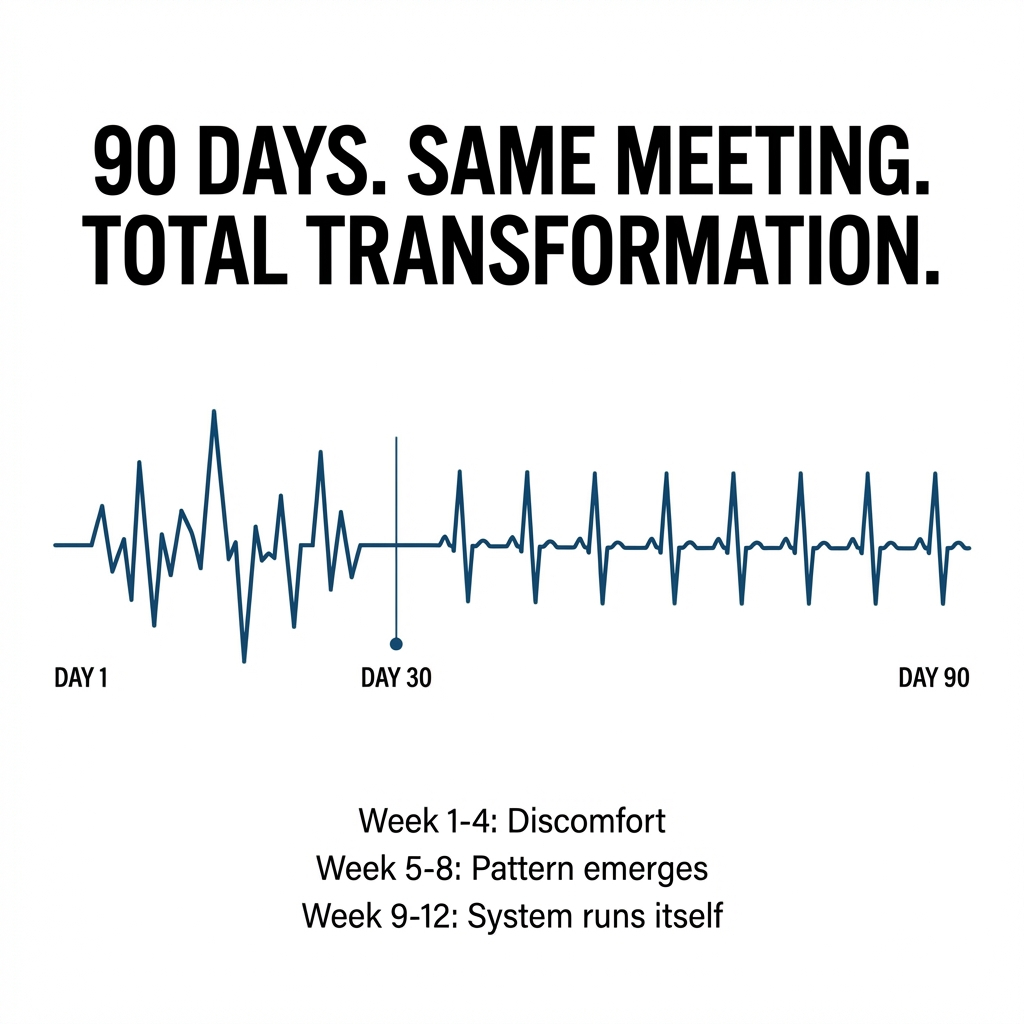
Week One Through Week Four
When we first install a consistent operating rhythm, the initial reaction is usually resistance disguised as skepticism. Leadership teams ask why they need another meeting. They already have too many meetings.
But here's what they're missing. Most meetings happen by accident. Every team has an operating rhythm, but most of these rhythms emerged without intention. They're artifacts of past urgencies, inherited from previous roles, or copied from companies that operated in completely different contexts.
We're not adding another meeting. We're replacing fragmented coordination attempts with a unified architecture.
The first four weeks expose the gaps. When you ask the same questions every week, you can't hide behind vague commitments anymore. "We're working on it" stops being an acceptable answer when you have to report progress on the same initiative for the fourth week in a row.
The discomfort is the point. You're forcing articulation where ambiguity used to live.
Week Five Through Week Eight
This is where the shift starts to become visible. The leadership team stops preparing for the meeting five minutes beforehand. They start tracking their commitments throughout the week because they know they'll need to report on them.
The meeting itself becomes faster. Not because we're rushing through the agenda, but because everyone knows exactly what's expected. The cognitive load of figuring out what to discuss has been eliminated.
We've seen this pattern enough times now to recognize it as structural, not coincidental. Teams that maintain a consistent meeting schedule are 30% more productive according to McKinsey research. That's not because the meeting itself is magical. It's because the rhythm creates accountability between meetings.
The real work happens in the six days between sessions. The meeting is just the forcing function that makes the work visible.
Week Nine Through Week Twelve
By week nine, something fundamental has changed. The system is starting to run itself. People bring problems to the meeting instead of trying to solve everything offline. They reference previous commitments without prompting. They hold each other accountable without the CEO having to police every interaction.
This is the transformation from personality-dependent coordination to system-embedded accountability. The founder's cognitive load decreases because the structure is carrying what their brain used to carry.
One client described it like this: "I used to spend every Sunday night mentally preparing for the week, trying to remember who was working on what and what needed my attention. Now the system remembers for me. I show up to the meeting and everything I need to know is already there."
The difference is measurable. Strategic Discipline research shows the impact becomes noticeable in 30 to 90 days. Not months. Not quarters. Weeks.
What We Learned About Rhythm vs. Strategy
Here's what surprised us most. The content of the strategy matters less than the consistency of the rhythm. We've watched mediocre strategies executed with disciplined cadence outperform brilliant strategies executed sporadically.
This goes against everything the consulting industry teaches. The field operates on the assumption that leadership teams improve through component addition. More tools. More training. More frameworks. More sophisticated complexity.
We operate on the opposite assumption. Leadership teams transform through integration into a singular architecture. The value comes from ruthless simplification that achieves self-sustainability.
The data supports this. Organizations with strong alignment between rhythm and goals see 19% faster revenue growth according to Gartner. McKinsey found that businesses aligning execution with organizational goals are 72% more effective at hitting targets.
That's not because alignment is inspirational. It's because alignment eliminates the friction of constant recalibration.
The Mechanics of What Actually Changes
When you run the same meeting every week for 90 days, you're not just creating accountability. You're building a distributed cognitive system that replaces individual memory with collective structure.
The meeting becomes the heartbeat. Everything else synchronizes to it. Planning happens in preparation for it. Execution happens in the intervals between sessions. Review happens within it. The entire operating system organizes around this single recurring event.
This is why partial adoption fails. You can't bolt a weekly rhythm onto a fragmented operating architecture and expect transformation. The rhythm has to become the architecture.
We've learned this the hard way. Early on, we'd let clients pick and choose which components to implement. They'd take the meeting structure but skip the metrics tracking. Or they'd track metrics but not enforce the commitment review process. Every time, the results were mediocre at best.
The system only works as a complete system. That's not us being rigid. That's physics.
Why Most Companies Never Get Here
The barrier isn't intellectual. Every leadership team we've worked with understands the logic immediately. The barrier is behavioral.
Consistency is uncomfortable. It exposes patterns you'd rather not see. It forces conversations you've been avoiding. It makes failure visible in a way that sporadic check-ins never do.
When you meet every week with the same agenda, you can't hide a struggling initiative for two months while you figure out how to fix it. You can't avoid addressing a performance issue because the next conversation is three weeks away. You can't skip the hard discussion because there's always next time.
There is no next time. Next time is in seven days, with the same questions, requiring the same level of specificity.
This is why having specific accountability appointments can boost goal achievement to 95% according to research. The appointment itself changes behavior before it even happens.
What We Tell Teams Starting Out
If you're considering implementing a consistent operating rhythm, here's what you need to know going in.
The first month will feel like overkill. You'll wonder if you really need to meet this often. You'll be tempted to skip a week because things are slow or everyone's too busy. Don't. The consistency is what builds the pattern.
The second month will feel mechanical. The meeting will start to feel routine, maybe even boring. That's exactly what you want. Boring means predictable. Predictable means the cognitive load is decreasing.
The third month is where you'll see the return. Decisions will happen faster. Alignment will require less effort. Problems will surface earlier. The leadership team will start to function as a unit instead of a collection of individuals.
After 90 days, you'll have built enough momentum that the rhythm sustains itself. Missing a week will feel wrong because the system expects it. That's when you know the architecture has replaced the personality dependency.
The Compound Effect Nobody Talks About
Here's the part that takes longest to become visible but matters most in the long run. When you install a consistent operating rhythm, you're not just improving coordination. You're creating a leadership development engine.
Every week, your leadership team practices the same skills. Articulating commitments. Reporting progress. Identifying obstacles. Requesting support. Holding peers accountable. Making decisions with incomplete information.
These aren't skills you learn in a workshop. They're skills you build through repetition in real context with real consequences. The meeting is the training ground. The week between meetings is the application environment.
After a year of this rhythm, your leadership team's capability has compounded in ways that no amount of episodic training could replicate. They've practiced these patterns 52 times. They've seen what works and what doesn't through direct experience.
That's the actual competitive advantage. Not the framework. Not the tools. The accumulated capability that emerges from disciplined repetition.
What We'd Do Differently Now
If we were starting over with what we know now, we'd be even more aggressive about rhythm consistency and even less flexible about exceptions.
We used to accommodate schedule conflicts. Someone's traveling, so we'll move the meeting. Someone's out sick, so we'll skip this week. Every accommodation weakened the pattern.
Now we treat the meeting like a heartbeat. If your heart skipped beats whenever things got busy, you'd be dead. The rhythm doesn't pause for convenience. That's what makes it reliable.
We'd also start measuring leading indicators from week one instead of waiting for lagging results. The transformation shows up in behavioral changes long before it shows up in revenue or profit. Track meeting attendance. Track commitment completion rates. Track how long it takes to surface problems.
Those metrics tell you if the system is working weeks before the financial outcomes become visible.
The Bottom Line
Running the same meeting every week for 90 days sounds simple. It is simple. But simple isn't the same as easy.
The difficulty isn't in understanding the concept. It's in maintaining the discipline when everything in your operating environment is pulling you toward fragmentation. When urgent issues demand immediate attention. When key people are unavailable. When the meeting feels redundant because nothing major has changed since last week.
Those are exactly the moments when the rhythm matters most. Because what you're building isn't a response to crisis. You're building a structure that prevents crisis through early detection and consistent correction.
We've now seen this pattern repeat enough times across enough different contexts to recognize it as a fundamental operating principle. Fragmentation compounds exponentially. Unity compounds linearly but predictably. Given enough time, predictable always wins.
The question isn't whether consistent rhythm produces better outcomes. The data and our direct experience both confirm it does. The question is whether you're willing to maintain the discipline long enough to see the transformation complete.
Ninety days. Same meeting. Same agenda. Same accountability structure. Every single week.
That's the mechanism. Everything else is just commentary.