
The Success Trap: Why 74% of High-Growth Companies Fail at Their Peak
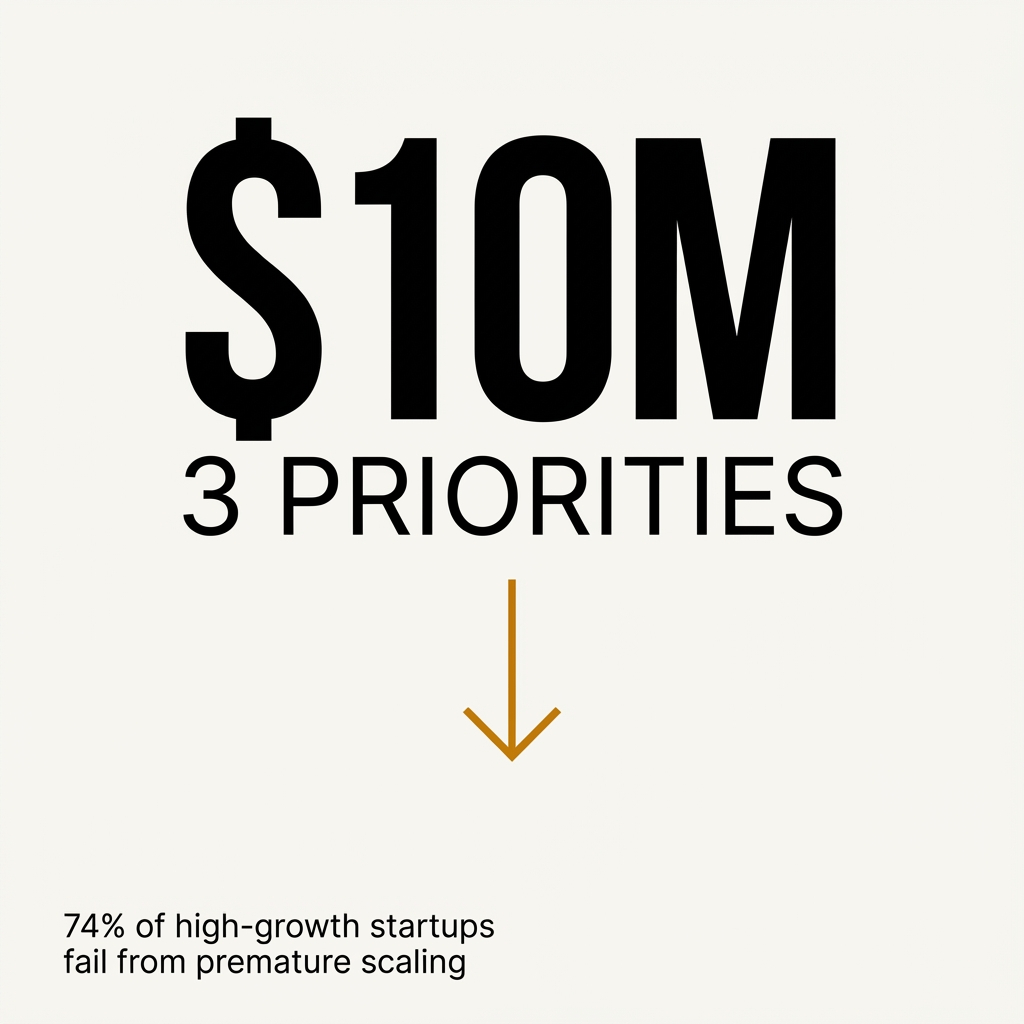
I watched a CEO celebrate hitting $10M in revenue on a Tuesday.
By Friday, he couldn't tell me which three priorities mattered most.
This wasn't a failure of ambition. It was something more dangerous: success that arrived faster than the architecture to sustain it.
The Startup Genome Project found that 74% of high-growth startups fail due to premature scaling. Not from lack of market fit. Not from running out of capital. From growing before the foundation could support the weight.
The structural collapse point isn't when things go wrong.
It's when things go right.
The Cognitive Ceiling Nobody Talks About
Your brain can hold 3-4 chunks of information in working memory at any time. That's it. About 20 seconds of processing capacity before the system resets.
When you're running a $2M company, that's enough. You know every client. You remember every commitment. Your instinct fills the gaps.
At $10M, the math changes. More people. More dependencies. More decisions that compound into consequences you won't see for months.
The coordination demand grows exponentially while your cognitive capacity stays flat.
This is where most leadership teams break. Not from incompetence. From hitting a biological ceiling that no amount of effort can overcome.
Research on cognitive load theory confirms what you already feel: when complexity exceeds the brain's processing capacity, performance collapses regardless of talent or determination.
The Instinct-to-System Inflection Point
I've seen this pattern repeat across dozens of companies:
Early stage runs on founder instinct. You make fast decisions because you hold all the context. Communication happens through proximity. Alignment emerges from shared struggle.
Then growth hits.
Suddenly you're in back-to-back meetings trying to keep everyone pointed in the same direction. You're the bottleneck on every major decision. People wait for you to tell them what matters because the system doesn't communicate priority anymore.
What worked at $2M becomes the constraint at $10M.
The Kauffman Foundation and Inc. studied the fastest-growing startups and found that two-thirds ultimately fail. Companies with rapid revenue growth performed worse long-term than slow-growing counterparts because increased overhead and operational complexity outpaced their ability to coordinate.
You can't solve this with harder work. You can't think your way out of a structural problem.
Why Leadership Teams Fragment Under Load
Here's what actually happens when organizational complexity exceeds the carrying capacity of founder cognition:
Meetings multiply but decisions don't. You spend more time talking and less time executing because nobody's clear on who owns what.
Priorities shift based on who spoke to you last. Without a unified system, the loudest voice wins. Strategy becomes reactive.
Accountability dissolves into ambiguity. When everything's important, nothing is. People default to what feels urgent instead of what matters.
The leadership team stops functioning as a unit. Each person optimizes their domain while the collective loses coherence.
Research shows that 82% of startups fail due to leadership or management issues. Not product problems. Not market problems. Coordination architecture failure.
The system breaks down from internal fragmentation, not external forces.
The Myth of Adding More Frameworks
Most companies respond to this crisis by adding tools.
A new project management system. Another communication platform. One more strategic planning framework. A consultant who brings a different methodology.
This makes the problem worse.
Each addition increases complexity without creating integration. You end up with more places to check, more systems to update, more frameworks competing for attention.
Fragmentation isn't solved by addition. It's solved by integration.
The companies that survive the transition don't accumulate more capabilities. They build a single operating architecture that connects strategy to execution, intention to rhythm, individual accountability to collective coherence.
What System-Embedded Coordination Actually Looks Like
The shift from instinct-based to system-embedded coordination requires a fundamental change in how leadership teams operate.
Instead of the founder holding all context, the system holds it. Instead of alignment happening through proximity, it happens through cadence. Instead of priorities shifting based on who you talked to last, they're locked into a rhythm that the entire organization can see.
This means:
Unified architecture over modular tools. One system that integrates strategy, execution tracking, and accountability rather than separate platforms for each function.
Measured progress over perceived effort. Visibility into what's actually moving forward, not just what feels busy.
Distributed leadership development. The operating rhythm itself builds capability across the team instead of concentrating it in one person.
Structural accountability that doesn't require enforcement. When the system makes commitments visible and tracks follow-through, you don't need to chase people down.
Complexity theory research on organizations shows that systems must maintain balance between flexibility and stability near the edge of chaos. Too much rigidity and you lose adaptability. Too much flexibility and coordination costs explode.
The architecture has to create enough structure to distribute cognitive load while preserving enough space for judgment and adaptation.
The Real Cost of Delayed Integration
Every month you operate with fragmented coordination, the gap widens.
Your team learns to work around the absence of system. They build personal workarounds. They create shadow processes. They stop expecting clarity because clarity never comes.
This becomes culture.
When you finally try to implement unified architecture, you're not just installing a system. You're fighting the accumulated weight of fragmented habits that feel like "how we do things here."
The companies that make this transition successfully do it before the crisis forces them to. They recognize the structural inflection point and act while they still have the stability to implement rhythm.
The ones that wait end up in emergency mode, trying to build the foundation while the building's already on fire.
The Path Forward
If you're experiencing the symptoms—meetings that don't produce decisions, priorities that shift daily, a leadership team that's working hard but not working together—you're at the inflection point.
You can't solve this by working harder. You can't think your way out. You can't add another framework and hope it sticks.
The solution is integration into singular architecture. A unified operating system that converts distributed instinct into coordinated execution.
This requires:
Willingness to externalize cognitive authority from individual to system. Letting the architecture hold what your brain used to hold.
Commitment to complete adoption rather than selective usage. The system only works when everyone's in it, not when people pick and choose which parts to follow.
Discipline to maintain cadence consistency even when it's uncomfortable. The rhythm produces results, but only if you protect it.
Focus on collective coherence over individual optimization. What's best for the system might not be what's easiest for any single person.
The companies that survive the growth transition don't do it through heroic effort. They do it through boring, disciplined rhythm that compounds over time.
They build the architecture before they need it. They install the system while they still have the capacity to implement it properly. They make the shift from personality-dependent momentum to system-embedded predictability before the collapse forces their hand.
Growth exposes every crack in your foundation.
The question isn't whether you'll hit the structural ceiling. The question is whether you'll build the architecture to break through it before success becomes the thing that breaks you.