
Exit Readiness for CEO-Led Companies: The 3-Year Plan
Here's the paradox every CEO discovers too late: the best time to make your company exit-ready is when you have no intention of selling it.
Exit readiness isn't a transaction project you start when a buyer calls — it's a property of how the company runs. And the ironic part is that everything a buyer pays a premium for is exactly what makes the company better to own: predictable growth, a leadership team that executes without the founder, clean forward-looking numbers, and a system that survives a change at the top. Exit-ready and well-run are the same thing. One of them just gets a valuation multiple attached.
What "exit-ready" actually means
A company is exit-ready when a sophisticated buyer can look at it and believe three things without squinting:
The growth is predictable, not episodic. Buyers discount hero-driven results and pay up for rhythm — quarters that land where the forecast said they would, several years running. A documented operating cadence with a track record of hit priorities is diligence gold.
The company is not the founder. The single largest discount in mid-market M&A is founder-dependence. If strategy, key relationships, and decisions live in your head, the buyer isn't purchasing a company — they're purchasing you, with a flight risk attached. (This is why building a business that runs without you is the exit plan, whether or not you ever sell.)
The numbers face forward. Historical financials get you to the table. What moves the multiple is a credible forward view: a rolling 36-month forecast, cash discipline, and unit economics the team — not just the CFO — can explain.
The 3-year exit plan is just a 3HAG™ with an exit lens
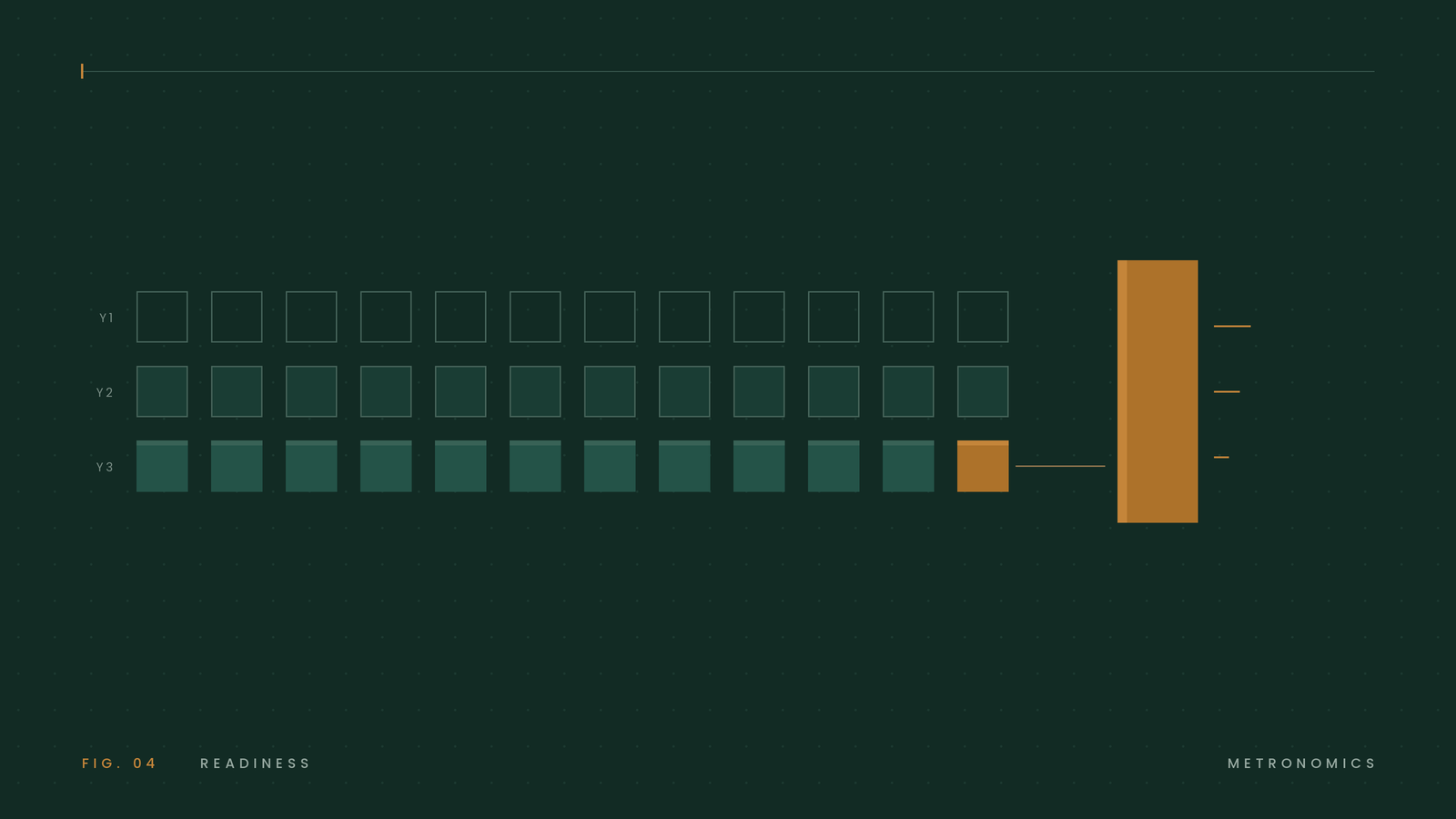
You don't need a separate exit methodology. A 3HAG™ — a 3-Year Highly Achievable Goal mapped month by month — is already the right instrument; pointing it at exit readiness means adding four swimlanes to the twelve quarters:
Quarters 1–4: Make it run without you. Install the operating system — visible strategy, decision rights, meeting rhythm, open scoreboard. This is the year that removes the founder-dependence discount, and it's also simply the Foundation Year of running a good company.
Quarters 3–8: Make the growth predictable. Two-plus years of forecast-vs-actual credibility takes two-plus years — you can't compress it later, which is why exit prep "when the buyer calls" always leaves money on the table. Hit your QHAGs. Keep the receipts.
Quarters 5–10: Make the team the asset. Buyers interview your leadership team and watch for eyes flicking to the founder before answering. A cohesive team that owns the numbers, debates openly, and stays post-close is worth turns of the multiple. Lock in the A-Players who'd be part of a buyer's thesis.
Quarters 8–12: Make the story clean. Documented systems, clean cash conversion, customer concentration addressed, and a data room that assembles in weeks not months — because the operating system already tracks everything a buyer will ask for.
Proof this works
This isn't theory from an M&A blog. Shannon Byrne Susko built and ran this system through two exits of her own — the second, Subserveo, sold in 3 years and 3 months at a valuation recognized as one of the top three mid-market deals on Wall Street that year. She was named Dealmaker of the Year in 2011.
Then her clients started doing it. Catherine Dahl ran Beanworks on the Metronomics system and sold to Quadient for $115M: "Metronomics gave us the system to scale fast and exit with confidence. It wasn't just me — our whole leadership team was aligned, executing, and accountable." That last sentence is the exit-readiness thesis in one line.
Start before you mean it
The uncomfortable truth about the three-year exit plan is the three years. Founder-independence takes 12–24 months to build honestly. Forecast credibility takes eight quarters of receipts. None of it can be reverse-engineered during diligence.
So start now, while selling is hypothetical — because every quarter of this plan makes the company better to own even if you never take a call. That's the real hedge: build the company a buyer would overpay for, and keep the option to keep it.
If you want the system installed rather than improvised, this is exactly what a certified Metronomics coach does — one layer per quarter, with your whole leadership team.
Frequently Asked Questions
How long does it take to make a company exit-ready?
Two to three years done properly: 12–24 months to remove founder-dependence, plus enough quarters of forecast-vs-actual history to make growth claims credible. Cosmetic exit prep can be done in months — and buyers price it accordingly.
What reduces a company's valuation most in a sale?
Founder-dependence, unpredictable results, and customer concentration — in roughly that order for CEO-led companies between $5M and $100M. All three are operating-system problems before they're M&A problems.
Should I tell my leadership team we're getting exit-ready?
Frame it accurately: you're building a company that runs predictably without the founder — which protects their careers and creates optionality, not a for-sale sign. Everything in the plan is what a great company does anyway.
Do I need an investment banker for this stage?
Not for readiness — bankers matter in the transaction year. The three years before that belong to you, your leadership team, and the operating system. Arrive at the banker's office exit-ready and the process gets shorter and the multiple gets better.